Mouse control in Scarborough is two jobs done together: trapping the mice already inside, and closing the gaps they used to get in. A treatment that only lays bait removes this month's mice while leaving the road open for next month's. Most Scarborough mouse jobs run $200 to $500, need one visit plus a follow-up, and carry our two-month guarantee. If you are hearing scratching in the walls after dark or finding droppings under the sink, that is a mouse, and fall is when they come indoors.
What are the signs of mice in your home?
The signs of mice are rice-sized dark droppings along walls and in the backs of drawers, scratching and scurrying in the walls and ceiling after dark, gnaw marks with shredded nesting material, and greasy rub marks where they run the same path each night.
What to look and listen for:
- Droppings the size of a grain of rice, dark and pointed, along baseboards, in drawers, and at the back of cupboards.
- Night scratching in the walls and ceiling, loudest once the house goes quiet.
- Greasy brown rub marks along baseboards and entry holes from the oil in their fur, the mark of a route run night after night.
- Gnaw marks on food packaging, wood, and wiring, plus small nests of shredded paper or insulation.
- A musky, ammonia smell in a pantry, closet, or cupboard.
As the nights cool, mice push into the postwar Birch Cliff, Cliffside, and Wexford bungalows through pencil-width gaps around pipes and worn door sweeps. Small, pointed droppings mean mice; blunt droppings roughly three times the size mean rats, and a different plan.
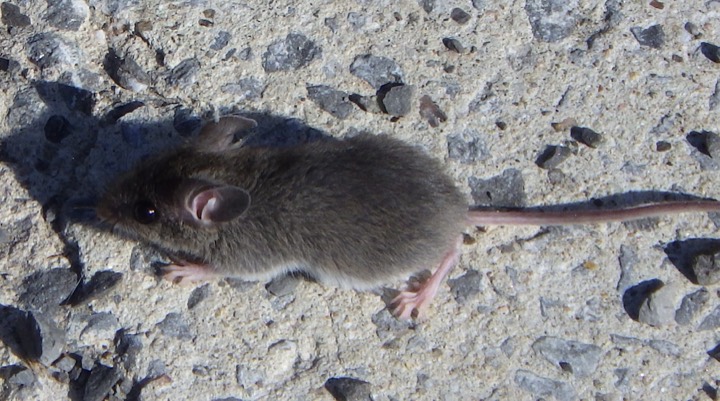

Why you suddenly have mice (and why it is almost always fall)
Mice head indoors as soon as the nights turn cold, which across Scarborough runs September through December. A house mouse only needs a gap the width of a pencil, about 6 millimetres, to slip inside, and Scarborough's postwar bungalows, back-splits, and side-splits offer plenty: the gap where the gas line enters, a worn garage door sweep, the weep holes in brick, a soffit corner, an aging foundation that has settled and cracked. One warm wall and a food source and they settle in for winter, breeding the whole time. A single female can produce five to ten litters a year. That is why "I only saw one" turns into a real problem fast, and why the fall call is the cheapest call.
A mouse problem is an entry problem. Kill the mice without sealing the gaps and you have bought yourself a monthly subscription, not a solution.
The signs it is mice, not something else
- Droppings the size of a grain of rice, dark and pointed, usually along walls, in the back of cupboards, or under the kitchen sink.
- Scratching or scurrying inside walls and ceilings, loudest at night when the house is quiet.
- A musky, ammonia smell in an enclosed space like a pantry or a closet.
- Gnaw marks on food packaging, baseboards, or wiring, and small piles of shredded paper or insulation where they nest.
- A greasy smudge along a baseboard or entry hole, from the oil in their fur on the same path run night after night.
Mouse droppings are small and pointed; rat droppings are three times the size and blunt. If the droppings are big, read the rat control page instead, because the plan is different.
How we actually clear them
- Inspection (free). We find the runs, the nest areas, and every entry point, inside and out. This is the step that decides whether they come back.
- Trapping and treatment. We place traps and, where appropriate, tamper-resistant bait stations that keep the product away from pets and children. Health Canada's rules require rodenticide near homes to be used in these locked stations, and we follow them. See the PMRA guidance on rodenticide safety.
- Exclusion, the part that lasts. We seal the entry points with steel wool, hardware cloth, and sealant that a mouse cannot chew through. This is what turns a treatment into a fix.
- Follow-up. We come back to clear traps, confirm the activity has stopped, and check the seals held.
Mice nest removal: what comes out, and how
Mice nest removal in Scarborough means finding the nests, taking out the shredded material and droppings without stirring them into the air, and sealing the spot so a new family does not move into the same warm corner. Mice build close to food and heat: behind the stove and fridge, under the dishwasher kick plate, in the bottom of a kitchen cabinet, in the insulation above an attached garage on a Woburn or Agincourt back-split, and along the box sill where the floor joists sit on the foundation. A nest looks like a loose ball of chewed paper, fabric, and pink or yellow fibreglass, usually with droppings packed around it.
Reachable nests come out once the mice are trapped, along with the soiled material around them. A nest closed inside a finished wall is usually left alone: once the mice are gone and the entry is sealed it is inert, and cutting open drywall rarely pays. Attic insulation that is heavily soiled is a job for an insulation contractor, and we will tell you when it has reached that point.
If you are cleaning up yourself, follow the Public Health Agency of Canada's hantavirus clean-up advice. Never sweep or vacuum mouse droppings; spray them and the nest with disinfectant or 1 part bleach to 9 parts water, let it soak 10 minutes, then wipe up wet. Wear rubber or plastic gloves and double-bag the waste.
What mouse control costs in Scarborough
A standard Scarborough mouse job comes to $200 to $500. Three things move the number: how many entry points need sealing, whether the mice have reached the attic or only the main floor, and the size of the home. A one-bedroom condo with a single entry sits at the low end. A two-storey back-split off Lawrence East with attic activity and half a dozen gaps sits at the high end, because the sealing is real work.
| Job | Typical Scarborough range |
|---|---|
| Condo / single unit, limited sealing | $200 to $300 |
| House, standard trapping + entry sealing | $300 to $450 |
| Larger home / attic activity / extensive exclusion | $450 to $600+ |
| Follow-up visit (included in most jobs) | usually no extra charge |
Waiting costs money here. A handful of mice in October is a $250 job; an established colony in the walls and attic by February is a $600 one. The full cost page breaks down every pest.
Do you need a pro, or can you do it yourself?
A single mouse caught in a trap, with no droppings and no scratching, is often a one-off you can manage yourself with a few snap traps and a tube of sealant. Call a pro once you are seeing droppings in more than one room, hearing activity in the walls, or catching mice faster than you can reset the traps. That means they are breeding inside, and store-bought traps alone will not out-pace them. Our honest do-I-need-an-exterminator guide walks through the line.
Do not use poison bait in an open dish if you have pets or young children. Health Canada requires rodenticides around homes to be in tamper-resistant stations for exactly this reason. If a mouse dies in a wall it can smell for a week, which is another reason trapping plus sealing beats bait-and-hope.
Keeping them out for winter
The mouse-proofing that earns its keep: a door sweep on the garage, steel wool packed into the gap where pipes and wires enter, quarter-inch hardware cloth over weep holes and vents, and food kept in glass or hard plastic rather than the cardboard boxes mice chew straight through. Because Scarborough is part of the City of Toronto, the Toronto property standards bylaw applies here too and requires properties to be kept free of rodents, and sealing is how you meet that without poison.
Mice in the walls in late October: what to do this week
The end of October is when Scarborough households start hearing mice in the walls and ceilings at night. The first sharp cold sends house mice out of the ravine edges along Highland Creek, the Rouge and the Bluffs, and out of backyards and gardens, toward the nearest warm wall. Health Canada puts the gap a mouse needs at the size of a dime (Health Canada, rats and mice).
How to get ahead of it before the ground freezes:
- Bungalows, back-splits and side-splits. Check the low points first: settled foundation corners, the basement window wells, and the gas meter entry. On a split-level, look hard at the joint where the lower level meets the upper one; it is a common gap.
- Basement floor drains. Toronto's Municipal Code Chapter 629 applies in Scarborough and requires floor drains to be screened with a metal grill (section 629-37). An uncovered drain in an older Scarborough basement is an easy way in.
- If they are already in the wall, trap, do not poison. A mouse that takes bait often dies inside the cavity, and you get a smell you cannot reach. Snap traps where they come out of the wall, under the sink, behind the stove and along the basement walls, then seal the outside once the catches slow down.
- Apartment towers. In a building of three or more storeys and 10 or more units, RentSafeTO applies. Report mice to the landlord in writing first, then call 311 if nothing happens.
Doing this in late October is cheaper than doing it in February, when a few mice in a wall have become a colony through the walls and attic.
Common questions
How do I get rid of mice permanently in Scarborough?
Trap the mice already inside and seal every entry point they used, then keep food in sealed containers and clutter down. Bait on its own will not do it, because it never closes the door they came through. A proper job includes exclusion, which is exactly why ours does.
How long does it take to get rid of mice?
Most homes are clear inside one to two weeks: the first visit sets traps and seals entries, and the follow-up confirms the activity has stopped. A heavy attic infestation can run longer.
Are mice dangerous?
They foul food and surfaces with droppings and urine, can carry salmonella and hantavirus, and their gnawing on wiring is a genuine fire risk. This is a health and safety problem, not just a nuisance.
What attracts mice into a house?
Warmth and food. Cold nights drive them toward any building with a gap and a crumb. Pet food left out, an open pantry, and clutter to nest in are what keep them once they have arrived.
Do I need to leave during mouse treatment?
No. Trapping and sealing do not require you to leave. If we use any product, we tell you about any area to stay off and for how long, per the label.
Why do I hear mice in my walls in late October?
Late October is when the first real cold pushes house mice in from Scarborough's ravine edges and yards toward warm walls. They enter through dime-sized gaps at foundations, window wells and pipe entries. Trap them where they come out of the wall rather than using poison, then seal the outside openings.
Is one mouse an infestation?
Not always, but mice seldom travel solo in winter. One caught with no other signs may be a stray. Droppings in more than one spot, or scratching in the walls, points to more than one.
Does the guarantee cover mice?
Yes. If mice are still active within two months of the treatment, we come back once at no charge.
What are the first signs of mice?
The first signs are usually rice-sized dark droppings along walls or in drawers and scratching in the walls after dark, often alongside gnaw marks and a musky smell. Fall is when mice move indoors, so early droppings in September or October are the warning worth acting on before they breed.
Do you remove mouse nests?
Yes. Reachable nests behind appliances, in cabinets, above a garage, or along the box sill are removed with the droppings and soiled material once the mice are trapped, and the entry is sealed. A nest closed inside a finished wall is usually left in place, since it is inert once the mice are gone and the gap is shut.
How do I clean up mouse droppings safely?
Do not sweep or vacuum them. The Public Health Agency of Canada advises spraying droppings and nesting material with disinfectant or 1 part bleach to 9 parts water, letting it soak 10 minutes, then wiping up wet with gloves on and double-bagging the waste.
Reviewed October 2026.
Prefer to talk? Call
(289) 806-3934Tell us the pest and your neighbourhood and we give you a price range on the spot. The inspection is free, and there is no charge to ask.
- Published price ranges, no "call for a quote"
- Free inspection, price locked before we start
- Licensed and insured technicians
- Two-month guarantee, one free re-treatment
- Honest advice if you do not need a pro yet
Scarborough & the GTA · Same-day, 24/7 for emergencies
Get a straight quote
Tell us what you are seeing and we come back with a price range and a time. No obligation, no on-site surprise.