A carpenter ant exterminator in Scarborough is paid to find the nest hidden in your wood and kill the colony there, which is why the job runs $250 to $500 rather than the price of a counter spray. Those big black ants marching through a kitchen in spring are not the little sugar ants. Carpenter ants set up their colony inside wood, and while they never eat it, they hollow out galleries through damp or rotting framing and, given enough time, they weaken it. Step one is always separating them from termites, since people mix the two up all the time and each calls for a different fix. Big black ants indoors plus little heaps of what looks like sawdust almost always means carpenter ants, and it almost always means water is getting into the structure somewhere.
Carpenter ant or termite? How to tell them apart
Start here, because it changes everything about the treatment and how worried you should be. Scarborough homeowners get a break on this one: termites do turn up in pockets of the GTA, but they are far rarer than carpenter ants, so that large dark insect on your baseboard is almost certainly an ant.
Here is how they differ if you can get a close look:
- Waist. Carpenter ants have a pinched, narrow waist between thorax and abdomen. Termites have a straight, thick body with no waist.
- Antennae. Ant antennae are bent, like an elbow. Termite antennae are straight and look like a string of tiny beads.
- Wings (on the flying ones). Both swarm, but a carpenter ant swarmer has two pairs of wings of different lengths, front pair longer. A termite's four wings are all the same length.
- What they do to wood. Carpenter ants excavate clean, smooth galleries and push the debris out. Termites eat the wood and pack their tunnels with mud. Carpenter ant galleries look sanded; termite damage looks dirty.
Carpenter ants do not eat wood. They excavate it to nest, and the tell is the sawdust they push out, called frass, piling up below the hidden gallery. If you are finding a small cone of coarse sawdust with bits of insect in it, that is frass, and it points almost straight at the nest above it.
Health Canada's Pest Management Regulatory Agency registers the products used for both, and both are worked by a licensed technician, but confirming which insect you have decides the whole plan. If it turns out to be small kitchen ants instead, the general ant control page covers those.
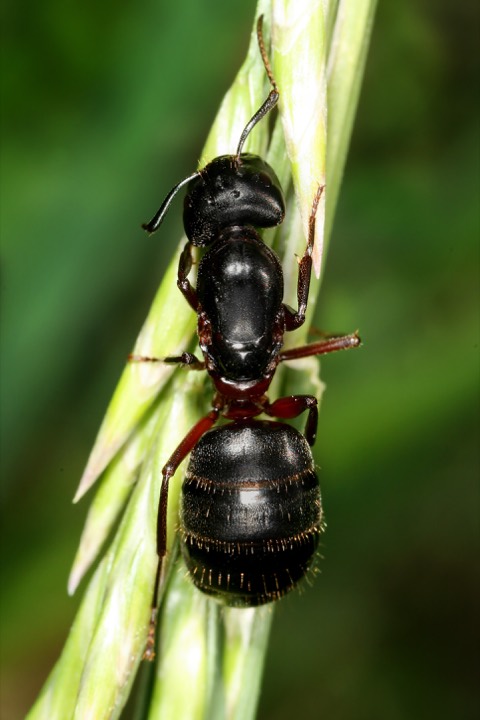

The signs it is carpenter ants
- Large black ants indoors, often a quarter to half an inch long, especially in spring and at night when they forage.
- Frass: small piles of coarse sawdust, sometimes mixed with insect parts and dead ants, under baseboards, in basements, below window frames or in the garage.
- A faint rustling or crackling inside a wall or ceiling void when the house is quiet, the sound of a large colony working the wood.
- Swarmers in May or June: winged carpenter ants gathering at a window are a strong sign of a mature nest inside the structure, not just foragers passing through.
- Ants concentrated around moisture: a leaky roof, a bad window seal, the wood around a bathtub, a damp basement sill. That is where they nest first.
Moisture is the root cause, always
Carpenter ants ignore sound, dry lumber. What draws them is wood that has already gone soft from damp, an old leak, or the start of rot. Scarborough's postwar housing stock hands them plenty of options: the mature treed lots in Guildwood, Cliffside, Cliffcrest, and Highland Creek drop years of shade and leaf litter that keep decks and porches wet, and the low-set basements in those 1950s and 60s bungalows and back-splits hold damp against the sill plate. Add a roof leak into the attic sheathing, a window that has wept into the framing, or a deck ledger that never dries out, and you have the soft wood a colony wants. Find the moisture and you have usually found the nest, or at least the reason it moved in.
Treating carpenter ants without fixing the moisture is a temporary fix. Clear the colony, leave the leak, and a new colony finds the same soft wood next season. Part of the real job is telling you what needs to dry out or be repaired.
Carpenter ant pest control vs regular ant control
Carpenter ant pest control is a structural job and regular ant control is a kitchen job, and the gap in price, $250 to $500 against $150 to $300, is the cost of the hunt. Pavement ants and odorous house ants come in from one nest outside or under the slab, and bait laid on their trail usually finishes the colony. Carpenter ants tend to keep a parent nest outdoors, in a stump, a fence post, or the woodpile, and push satellite nests into the house: a sill plate, a window header, the rim joist above a damp basement.
Bait alone can miss a satellite. So the technician traces where the workers actually travel, taps and probes the wood, and treats the gallery itself. On a Cliffcrest or Guildwood lot with a cedar hedge and firewood stacked along the fence, the parent nest may be in the yard or even next door, which is one more reason a spray along the baseboard changes nothing.
What a carpenter ant exterminator actually does
A carpenter ant exterminator finds the nest, treats the colony inside the wood, and tells you what moisture drew it there. A repeat call almost always traces back to a technician who killed foragers and never located the nest, because hitting the trail does nothing to the colony living in the wall.
- Inspection (free). We follow the trails, look for frass, sound out the wood, and locate the moisture. Carpenter ants often keep a main nest outdoors, in a stump, woodpile, or fence post, and satellite nests inside the home. We trace both.
- Find and treat the nest. Once the nest or gallery is located, we treat it directly, and we bait or treat the trails the workers use between the outdoor parent nest and the indoor satellite, so the whole colony is hit, not just the part you saw.
- Address the source. We tell you the moisture problem feeding them: the leak, the rot, the wood-to-soil contact. Fixing that is what keeps the next colony out.
- Follow-up. We return to confirm activity has stopped and the frass is not building back up.
What carpenter ant control costs in Scarborough
Expect a carpenter ant job in Scarborough to fall in the $250 to $500 band, above what general ants cost, because the value sits in tracking a concealed nest and treating the structure rather than wiping down a counter. Where you land depends on how easy the nest is to reach, whether satellites are involved, and how much of the framing is in play.
| Job | Typical Scarborough range |
|---|---|
| Single accessible nest, standard treatment | $250 to $350 |
| Multiple satellite nests / larger home | $350 to $500 |
| Extensive structural involvement | $500+, quoted after inspection |
| Follow-up visit (included in most jobs) | usually no extra charge |
The moisture repair (roofer, carpenter, waterproofing) is separate and not our work, but we will tell you plainly what needs doing. Every pest and its price is on the full cost page.
Do you need a pro, or can you do it yourself?
This is one of the few pests where the do-it-yourself route almost never lands, because the entire problem is a nest you cannot see. A shelf bait might thin out the foragers for a while, but it will not locate the gallery inside the wall or the parent colony out in the yard, and it leaves the moisture that invited them untouched. Regular big black ants indoors, frass on the floor, or any noise in the walls, that is a call. Our honest do-I-need-an-exterminator guide covers where the line sits.
Anyone can kill the ants on your counter. The job worth paying for is finding the nest and telling you why it was there.
Common questions
Are carpenter ants as bad as termites?
They work slower and do less damage than termites, but a big, well-established colony sitting in your framing for years will eventually weaken it, and around Scarborough you are far more likely to meet them than termites. It comes down to speed: termites can wreck a structure quickly, carpenter ants chew away gradually, and neither one should be left.
Do carpenter ants eat wood?
No. They tunnel through wood to build the nest and shove the shavings out as frass, but none of it goes down as food. Like other ants, they are out hunting sugars and proteins, which is exactly why bait reaches them.
Why do I only see them at night?
Foraging peaks after dark for carpenter ants, especially once the weather warms up. A column of large black ants along the counter in the evening, or crossing the floor at night, is normal for them and is often the first solid clue that a nest is nearby.
What do the winged ones mean?
Those winged carpenter ants are swarmers, and they show in May and June when an established colony releases reproductives. Spotting them indoors, particularly clustered at a window, usually means the nest is inside the building rather than out in the yard, and it is a strong cue to get an inspection.
How do I stop them coming back?
Deal with the water. Patch leaks, move drainage away from the foundation, pull firewood and mulch back off the walls, cut branches off the roofline, and swap out any wood that stays wet. Soft, damp wood is what a colony needs, so a dry structure is the real defence.
Do I need to leave during treatment?
No. You do not have to clear out for carpenter ant work. If a product goes down, we point out any spot to stay off and for how long, following the label directions.
Does the guarantee cover carpenter ants?
Yes. If carpenter ants are still active within two months of the treatment, we come back once at no charge.
How much does a carpenter ant exterminator cost in Scarborough?
Most carpenter ant jobs in Scarborough run $250 to $500, depending on how hard the nest is to reach and whether satellite nests are involved. That sits above the $150 to $300 for kitchen ants because the work is tracing a hidden nest. Heavy structural involvement is quoted after the free inspection.
Is carpenter ant control different from regular ant control?
Yes. Regular ants are usually cleared with bait on the trail. Carpenter ants nest inside damp wood, often with a parent nest outdoors and satellites in the house, so the nest has to be found and treated directly and the moisture behind it fixed.
Reviewed October 2026.
Prefer to talk? Call
(289) 806-3934Tell us the pest and your neighbourhood and we give you a price range on the spot. The inspection is free, and there is no charge to ask.
- Published price ranges, no "call for a quote"
- Free inspection, price locked before we start
- Licensed and insured technicians
- Two-month guarantee, one free re-treatment
- Honest advice if you do not need a pro yet
Scarborough & the GTA · Same-day, 24/7 for emergencies
Get a straight quote
Tell us what you are seeing and we come back with a price range and a time. No obligation, no on-site surprise.